The further back in time you go, it becomes harder and harder to find useful historical records. In England, parish registers were used to catalogue baptisms, burials, and marriages that occurred in each parish. The original mandate to keep parish registers was championed by Thomas Cromwell and issued by Henry VIII in 1538. The registers were written by the parson, vicar, or curate in each parish; they were originally written in Latin until 1733 when the language was discontinued in favour of English. These older records are often very challenging to read, partially incomplete, or have not survived at all. The completeness and overall survival of the records improved greatly throughout the 1700s and into the 1800s.
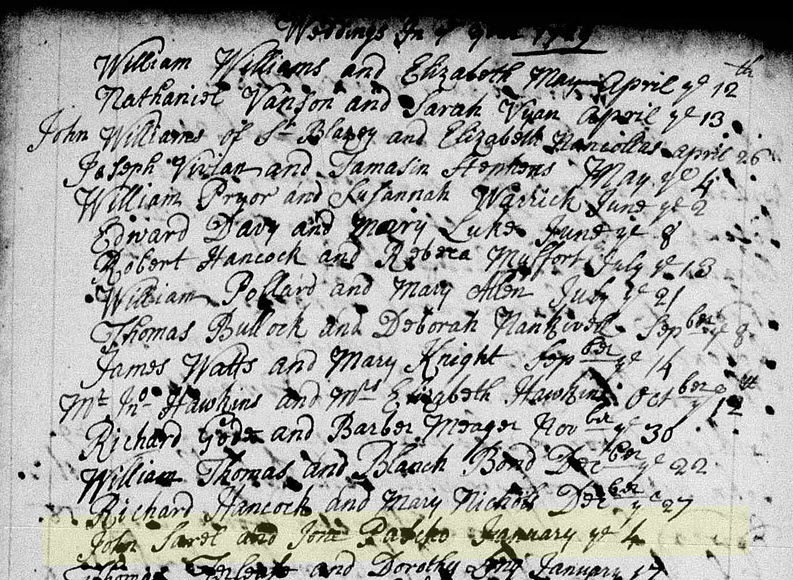
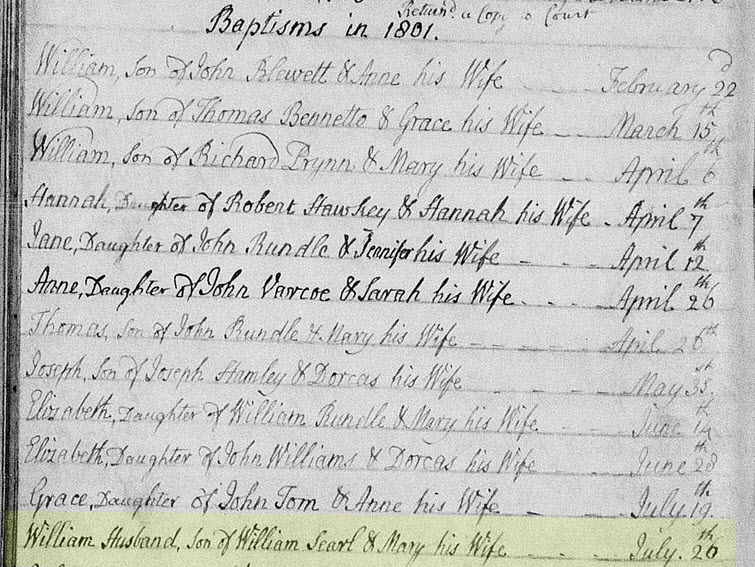
One of the major challenges with the parish records is that they lack information that connects individual people to their parents. While a baptism record will state the father’s full name and the mother’s first name, they do not list the mother’s maiden/birth name. Marriage records also do not list who the parents of each person are. For these reasons, linking people requires making logical connections and educated guesses in some cases, which inevitability reduces the accuracy of the ancestral links.
Approaching the 1850s and into the 1860s, with the Searle and McGinn ancestors having already migrated to North America, the historical records become much more useful. Most of the records contain the maiden name of the women contained in them: birth records contain the maiden name of the mother and marriage records, contain both the maiden name of the bride as well as the maiden name of the bride and grooms mothers. This additional information makes it possible to provide a 100% accurate link between an ancestor and their descendant.
For the ancestors of Arthur Samuel Thomas Searle, he can be linked with 100% accuracy to William Husband Searle and Anne Hill, his great grandparents. Arthur Searle's birth, marriage, and death records all list his parents names; Arthur's father's marriage record and newspaper obituary include his parents names (Arthur's grandparents), and the 3rd marriage record of Arthur's grandfather, thankfully, lists his parents names.

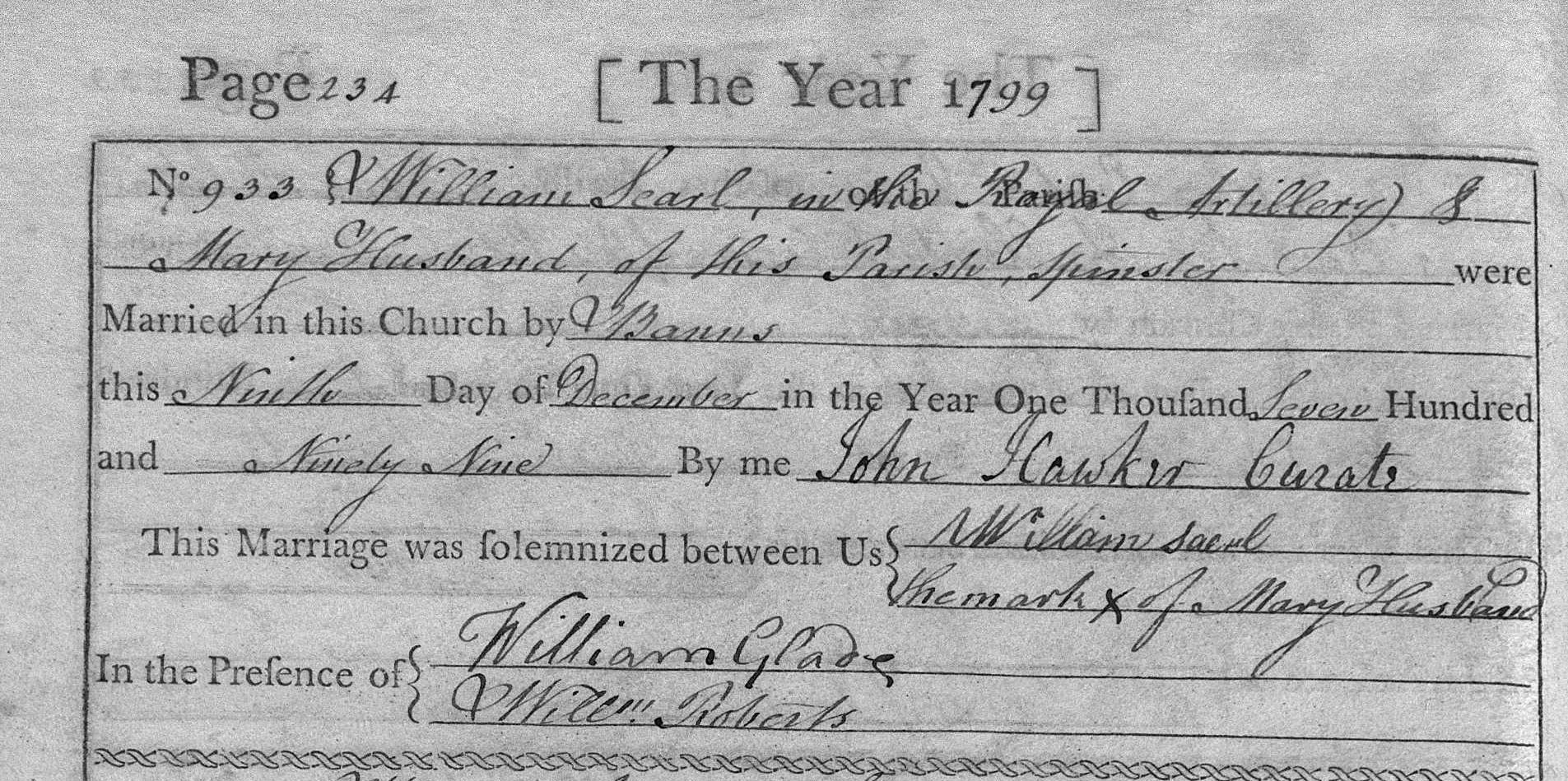
The parents of Arthur's great grandfather, William Husband Searle, are likely accurate, however, there is no record specifically linking William Husband Searle to them; linking William Husband Searle to William Searl and Mary Husband requires some logical reasoning and educated guessing. It appears that for some English families, they chose to include the mother’s maiden name as a middle name for some of their children. Husband is not a very common English first or middle name; therefore, it is likely that the maiden name of William Husband Searle’s mother is Husband. There are no marriage records in Cornwall at all between a Searle and Husband anywhere near the time of William Husband Searle’s baptism. In Stoke Damerel, Devon, which is about 38km east of Tywardreath, where Mary Husband was baptised, there is a marriage record of William Searl and Mary Husband. In 1801, the baptism record of “William Husband, son of William Searl and Mary his wife”, appears in the parish registers of Tywardreath. Given that William Searl is listed as being in the Royal Artillery on the marriage record, there’s a good chance that while William was away serving in the Royal Artillery, Mary lived with her family in Tywardreath and gave birth to William Husband Searle. Tywardreath is also only about 7.25km to the east of St. Austell, where all the likely ancestors of William Searl were located. Lanreath, where William and Mary have their last four children and are buried, is 10km east of Tywardreath. All this information helps establish a likely ancestral link from the son to his parents, however, it cannot be proven with 100% accuracy from the available sources.