William Husband Searle, the son of William Searle and Mary Husband, married Anne Hill in the Parish of St.Pinnock, Cornwall, England on July 12th, 1818. Anne Hill, the daughter of John Hill (Unknown – 1803) and Mary Peak (1769 – 1839), was baptised in the Parish of Liskeard, Cornwall, England on July 1st, 1800. William and Anne lived in Braddock (also known as Broadoak), Cornwall; Braddock, Lanreath, Liskeard, and St. Pinnock are all within about 10 km of each other in Southeast Cornwall. They had 6 children in Braddock between 1819 and 1832: Joseph (1819 – 1883), John (1820 – 1888), Mary (1823 – 1888), Phoebe Elizabeth (1827 – 1903), Catherine (1829 – 1829), Catherine (1831 – 1894), and William Albert (1832 – 1898).

During this time in Braddock, William was working as a labourer. In 1832, the family came upon hard times and ended up living in a poorhouse: this was their residence as listed on the baptism record of their son William Albert on July 1st, 1832. Poorhouses were part of poor relief in England; poor relief, essentially a form of what modern North American society calls welfare or social assistance, started as a means to help people in need. The 1601 Poor Relief Act gave parish officials the legal ability to collect money from rate payers to spend on helping the poor, often through outside relief: handouts of bread, clothing, fuel, etc. In the earlier years of the system and in more rural areas where the populations were relatively small, the overseers of the poor would be able to somewhat efficiently manage the system since they knew all the people in the parish – this helped them differentiate the deserving poor: the ill, the elderly, or the able-bodied people that just couldn’t find enough work or came upon challenging times; and the undeserving poor: able-bodied people who they believed refused to work, or “beggars”. The type of relief changed throughout the 18th century and switched to inside relief, which started with the Workhouse Test Act of 1723. Inside relief required the poor to enter a workhouse (also known as a poorhouse, depending on the region), with occupants working the farm, maintaining local roads, and helping with other parish works in exchange for food, shelter, clothing, and other basic needs. The system changed significantly with the Poor Law Amendment Act of 1834 (often called the New Poor Law), which began the more infamous workhouse era made famous by Charles Dickens’s Oliver Twist and other celebrities such as Charlie Chaplin, who spent many years in a workhouse when he was younger. Many accounts of workhouses show them as cruel systems, designed to shame the poor for being poor. While more is known about workhouses following the New Poor Law, what workhouses or poorhouses were like in more rural areas, such as the one the Searle family found themselves living in in 1832, is not as well known.
Following the end of the Napoleonic Wars in 1815, which saw the deaths of roughly 3.5 million people in Europe (approximately 310,000 from England) and cost all involved countries large amounts of money to fund, Europe was plunged into an economic and agricultural depression. To combat the agricultural depression and force the purchase of English corn (a term used to categorize all cereal grains), the British government passed the Corn Laws in March 1815. These laws blocked the import of cheap corn through tariffs and other trade restrictions, making it too expensive to import from outside England, even when food supplies were short. While the laws enhanced the profits and political power associated with land ownership, it increased food prices and the overall cost of living for the general public. This led to many people being plunged into poverty.
The economic depression following the Napoleonic Wars, combined with the Corn Laws, placed a great strain on the poor relief system. One cheaper alternative to the poorhouses and workhouses of the time was to provide qualified poor people, the “deserving poor”, money for passage or land grants in other countries, such as Lower and Upper Canada. It is likely that the Searle family, who had prior to 1832 been living on their own means, qualified as “deserving poor” that could be sent to the New World for a new life, one which did not put further strain on the poor relief system of England.
In 1832 or 1833, the family of William Husband Searle and Anne Hill, left the only country their ancestors had known for generations.
While steam liners eventually made the journey across the Atlantic much faster (starting in 1838), cross-Atlantic travel in 1832 or 1833 relied on traditional sails, with the voyage usually taking between 4 to 6 weeks to complete. Ship conditions at this time were often very poor: cramped living space, poor quality food (bread, biscuits, and potatoes), and often poor drinking water all helped make the voyage quite miserable. Fires, disease outbreaks, and shipwrecks made the journey perilous as well; in 1832 there were large outbreaks of cholera and in 1834, 17 ships were shipwrecked in the Gulf of St. Lawrence, resulting in the deaths of 731 emigrants.
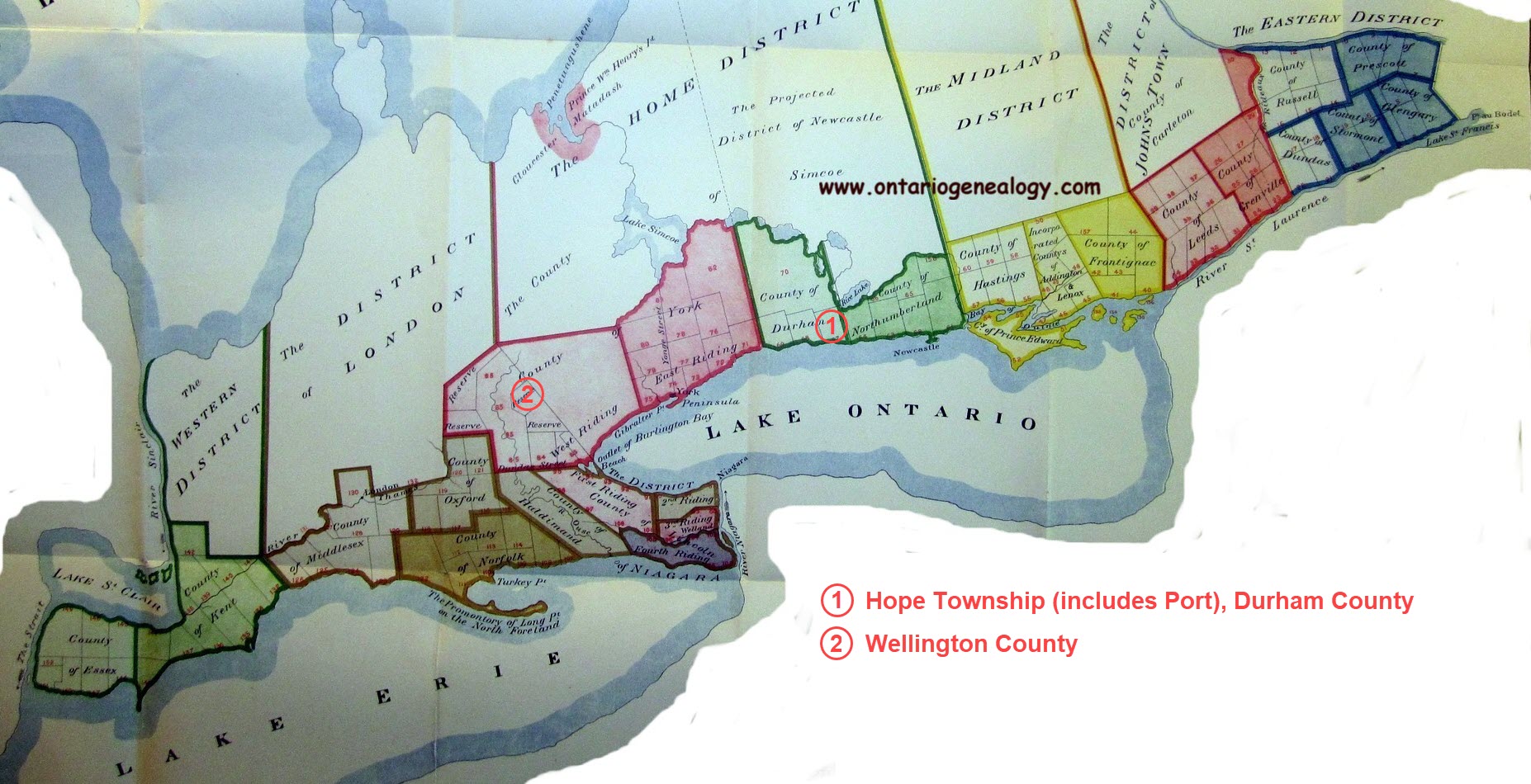
Despite all the dangers and hardships, the Searle family made it safely across the Atlantic Ocean, down the St. Lawrence River and into Lake Ontario, finally landing at Port Hope in Durham County, Upper Canada.
William Searle first appeared in Upper Canada on the 1836 assessment records for Hope Township, Durham County. He is listed as living with 10 people in the household: 2 adult males (William and their oldest son, Joseph), 1 adult female (Anne), 2 male children (John and William Albert), and 5 female children (Mary, Phoebe, Catherine, and two daughters born in Upper Canada: Alice and Matilda). The following year, the couple welcomed their last child, Henry.
For the rest of the 1830s and 1840s, the family remained in Hope Township, living on Lot 32, Concession 3 and then Concession 2.